The short answer
If you want the lowest cost and the easiest future repairs, choose plain concrete with a broom finish. If you want grip on a slope, a finish that hides dirt and tyre marks, and a more designed look, choose exposed aggregate. If you want a particular colour to match the house, choose coloured concrete, and accept that colour can vary and patches are harder to match.
All three are built on the same foundation: an excavated and compacted base, reinforcement on chairs, a suitable thickness, properly placed joints and good curing. If any of those are poor, the finish on top will not save the driveway. Our concrete driveways page covers how the slab itself is built.
How each finish is made
Plain concrete
Standard grey concrete is placed, screeded and floated, then finished. Most Sydney driveways get a broom finish: a stiff broom dragged across the surface leaves fine ridges that give tyres and shoes grip. Edges are usually tooled with a smooth border. Some driveways get a smoother steel trowel finish, but that can be slippery when wet and is better suited to garage floors.
Exposed aggregate
Exposed aggregate uses a mix with decorative stone. After placing and finishing, the top layer of cement paste is removed, usually by applying a surface retarder and washing it off at the right time, to reveal the stone. The stone blend controls the look, from light river pebbles to darker basalt. Many exposed driveways are sealed once they have cured.
Coloured concrete
There are two common methods:
- Integral colour: oxide pigment is mixed through the whole load at the plant, so the colour goes right through the slab.
- Surface colour: a colour hardener is broadcast onto the fresh surface and worked in, so the colour sits in the top layer.
Coloured concrete is usually sealed to protect and enrich the colour. Stencilled and stamped finishes press a pattern into coloured concrete to imitate pavers or stone, and these are almost always sealed.
Side-by-side comparison
| Plain (broom) | Exposed aggregate | Coloured | |
|---|---|---|---|
| Look | Simple grey, clean lines | Textured stone, designed look | Solid colour, from light to charcoal |
| Grip | Good with a broom finish | Very good | Depends on the surface finish and sealer |
| Hides dirt and tyre marks | Least | Most | Moderate; dark colours show dust and pale colours show tyre marks |
| Heat underfoot | Moderate | Depends on the stone colour | Dark colours get hot in full sun |
| Sealing | Optional | Common | Usually |
| Patching later | Easiest to match | Stone blend can be matched with care | Colour matching is difficult |
| Relative cost | Lowest | Higher | Higher |
Grip and Sydney slopes
Sydney has plenty of steep driveways, particularly on the North Shore, in the Eastern Suburbs and on sloping estates in the Hills District. Grip matters most when it is wet, when leaves have fallen, and when moss grows in shaded strips.
Exposed aggregate has the most surface texture, so it is the usual choice for steep driveways. A heavy broom finish on plain concrete is also grippy. Some very steep driveways get grooves cut across them. Whatever the finish, a high-gloss sealer can make the surface slick, so ask for a sealer suitable for driveways and slopes, and ask about anti-slip additives if needed.
Heat, glare and light
A large concrete driveway reflects and stores the sun's heat. Pale finishes reflect more light and stay cooler underfoot. Charcoal and dark colours absorb more heat, which can make them uncomfortable for bare feet in a Western Sydney summer and can make them look dusty. Exposed aggregate sits somewhere in between, depending on the stone and cement colour.
If the driveway is also where kids play or where you walk barefoot to the pool, a lighter finish is the more comfortable choice.
Stains and day-to-day cleaning
Oil drips, tyre marks, rust from garden furniture, leaf tannins from gum trees and red soil washed down the driveway all show differently:
- Plain concrete shows stains and tyre marks most, especially when new and light grey.
- Exposed aggregate hides marks well because the stone breaks up the surface.
- Coloured concrete depends on the colour: dark colours hide oil better but show dust and white efflorescence, while light colours show tyre marks.
Sealers help all three resist stains. Sealed surfaces need resealing over time as the sealer wears, especially on driveways that get heavy use.
Cracking and repairs
The finish does not change whether a driveway cracks. Cracking comes from shrinkage, ground movement, tree roots, overloading and poor base preparation, and is controlled by joints and good construction. What the finish changes is how cracks and repairs look.
- Plain concrete can be patched or have a panel replaced, and new grey concrete weathers to a similar tone over time.
- Exposed aggregate can be matched if the same stone blend is available and the concreter takes care, but the new section will look different at first.
- Coloured concrete is the hardest to patch, because colour varies between loads and with weathering. A replaced panel often stands out.
Joints help here too. If repairs are needed, it is easier to replace a whole panel between joints than to patch inside one.
Cost compared
Plain concrete is the cheapest of the three. Exposed aggregate and coloured concrete cost more because of the decorative materials, extra labour and usually a first seal. The difference per square metre is noticeable across a whole driveway. Demolition of the old driveway, excavation, access and the crossover are the same whichever finish you choose, so the finish is only part of the total.
Our Sydney concrete price guide gives 2026 planning bands for plain and decorative concrete, and explains what else moves the price.
Matching the house and street
A driveway is one of the largest surfaces seen from the street. A few practical points:
- Older brick homes, such as the post-war houses common across Western Sydney, often suit plain concrete or a warm exposed aggregate.
- Federation and Victorian homes in the Inner West and Eastern Suburbs often look best with simple plain concrete or a restrained exposed aggregate.
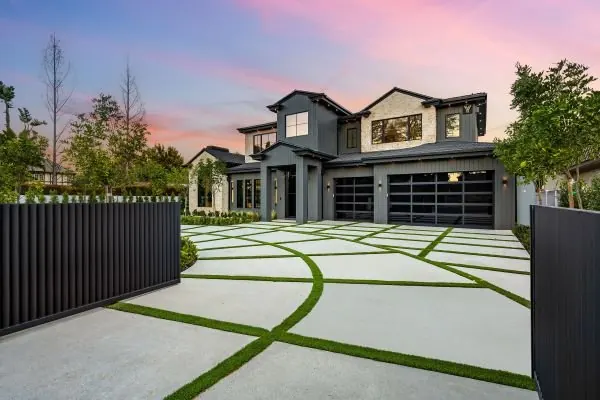
- New builds with dark cladding and contemporary lines often pair with charcoal coloured concrete or large plain panels with grass joints.
- Strata and townhouse driveways often use exposed aggregate because it hides wear from many cars.
Check whether your council has rules for the crossover finish. Some councils specify a plain concrete finish for the section on council land, whatever you choose for your own property.
Sealing and maintenance
Sealing is optional on plain concrete and common on exposed aggregate and coloured concrete. A sealer helps resist stains, enriches colour and makes cleaning easier, but it also wears and needs reapplying. Ask your concreter:
- what type of sealer they propose
- whether it reduces grip
- how long they expect it to last before resealing
- what cleaning products are safe to use on it
Keep gutters and downpipes from discharging onto the driveway where you can, sweep off leaves that stain, and deal with oil drips while they are fresh.
Questions to ask before you choose
- Is the driveway steep, shaded or likely to be wet often?
- Will kids, pets or bare feet be on it in summer?
- Do you want stains and tyre marks to show less?
- How likely is it that part of the driveway will need to be dug up later for services or plumbing?
- What does the council require for the crossover?
- What is the budget, including demolition, base and the crossover?
Answering those usually points clearly to one of the three. If you are still unsure, ask the concreter to bring samples or show examples, and look at driveways of the same finish that are a few years old, not just freshly sealed ones.
Getting quotes
When you ask for quotes, specify the finish and ask each concreter to list the thickness, reinforcement, base preparation, joints, sealing and crossover work. That way you can compare like with like. Call us or send the job details below for a free on-site quote anywhere in Sydney.